
Most people don’t think about car towing until they’re standing on the shoulder of a Dallas highway, phone in hand, wondering if this situation actually requires a tow truck, or if they’re overreacting.
That hesitation is completely normal. Towing isn’t something most drivers deal with often enough to feel confident about, and that uncertainty can waste precious time when a vehicle is stuck in an unsafe spot.
This guide explains exactly what car towing is, the situations that genuinely call for it, how the process works from the first phone call to your car’s safe delivery, and what it typically costs in the Dallas–Fort Worth area, so you can make a fast, informed decision the next time your car won’t cooperate.
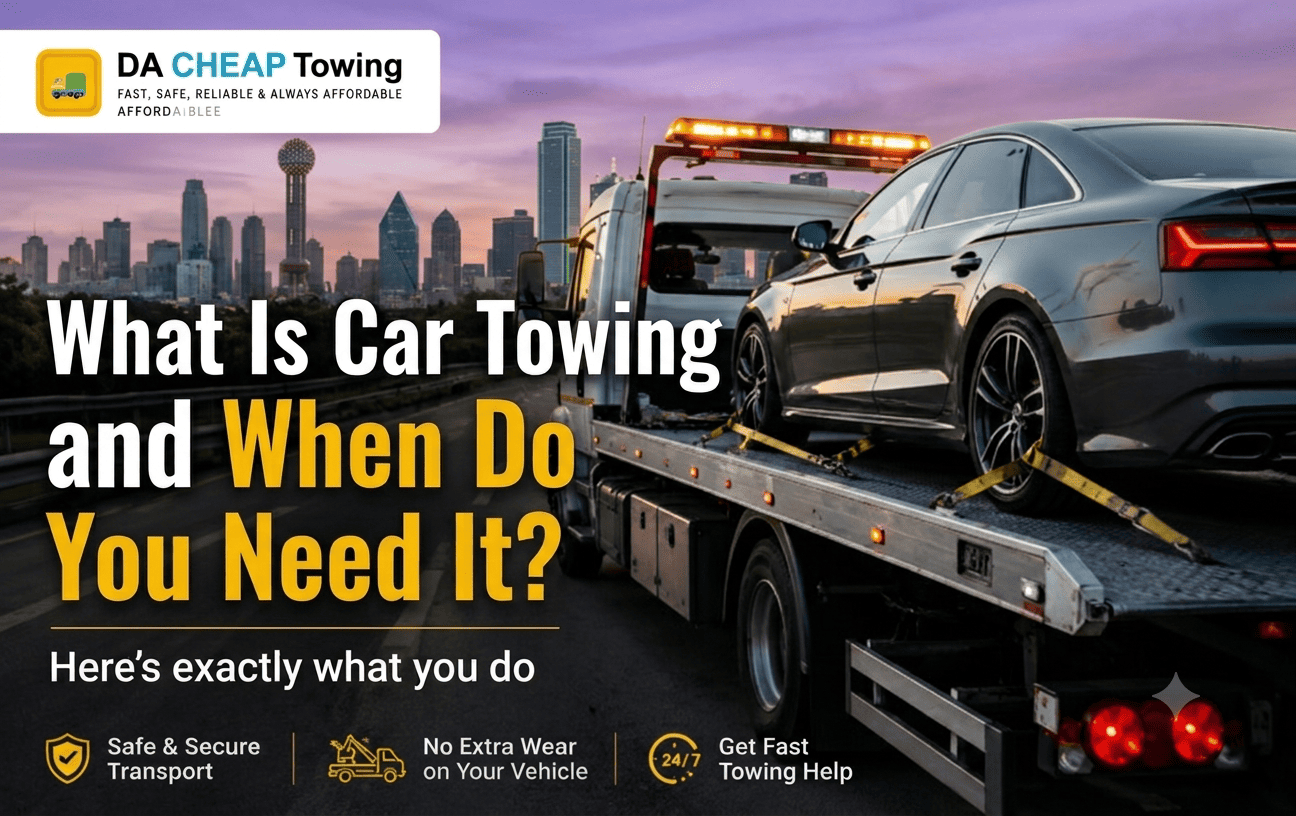
Car towing is a professional service that transports a vehicle that can’t or shouldn’t be driven, using either a flatbed truck (vehicle fully lifted, wheels off the ground) or a wheel-lift truck (front or rear wheels raised, others rolling).
You need car towing whenever your vehicle won’t start, has a mechanical failure, was in an accident, has a flat with no usable spare, or is an all-wheel-drive vehicle that can’t be safely moved any other way. In Dallas–Fort Worth, towing typically starts around $85 and takes 30–45 minutes to arrive, depending on distance and vehicle condition.
What Car Towing Actually Means
Car towing is the transport of a vehicle from one location to another using specialized equipment, when the vehicle itself isn’t in a condition to be driven — or when driving it further would risk additional damage or safety issues.
There are two main methods used for passenger vehicles:
Wheel-lift towing raises either the front or rear wheels off the ground while the other set stays on the road and rolls during transport. It’s a common, cost-effective method for straightforward local tows of standard, operable vehicles.
Flatbed towing lifts the entire vehicle onto a level platform, so no part of it touches the road during transport. This method is used whenever a vehicle needs extra protection — non-running cars, all-wheel or four-wheel-drive vehicles, low-clearance and luxury cars, electric vehicles, and anything involved in an accident.
A reputable towing company doesn’t default to one method for every job. The right equipment depends on your specific vehicle and its condition, which is why the dispatcher should always ask about your car’s drivetrain and situation before sending a truck.
When Do You Actually Need Car Towing?
This is the question most drivers get stuck on. Here’s a clear breakdown of situations where towing isn’t optional — it’s the safest and often the only responsible choice.
Your engine won’t start, and a jump-start doesn’t fix it. A dead battery is sometimes solvable roadside. But if the issue is deeper — alternator failure, a fried starter, or an electrical fault — no amount of jumping the battery will get you moving, and continuing to try can drain your battery further or damage the electrical system.
Your car overheated or is showing signs of major mechanical failure. Driving a few more miles on an overheating engine can turn a repairable problem into a replaced engine. If your temperature gauge is climbing into the red or you smell burning, stop immediately and call for a tow rather than pushing forward.
You have a flat tire and no usable spare. If your spare is also flat, missing, or your vehicle only has a tire inflator kit that hasn’t solved the problem, driving on a flat — even slowly — damages the wheel, and sometimes the suspension.
You were in an accident and the car is undriveable or unsafe. Even a vehicle that seems to run fine after a collision can have hidden frame, suspension, or steering damage. Towing to a body shop for inspection is the safer call, and often required if the vehicle isn’t roadworthy.
Your transmission has failed or won’t shift. A car that won’t move under its own power, or is stuck in one gear, needs to be transported rather than forced to drive.
You drive an AWD or 4WD vehicle and it’s disabled. This one surprises a lot of drivers. All-wheel and four-wheel-drive vehicles generally cannot be safely wheel-lift towed, because the drivetrain can engage while two wheels are on the ground and the engine is off — leading to expensive transfer case or transmission damage. These vehicles need flatbed transport specifically, every time.
Your car is stuck in mud, a ditch, or off a road surface. This requires winch-equipped recovery, not a standard tow — the vehicle needs to be pulled back onto solid ground before it can be loaded and transported.
You’re relocating or transporting a vehicle you’re not driving. Buying a car from out of state, moving a non-daily-driver, or delivering a vehicle to a dealership or storage facility are all standard, non-emergency towing needs — no breakdown required.
What to Do Before the Tow Truck Arrives
Once you’ve decided towing is necessary, a few small steps make the process faster and safer:
- Pull as far off the road as possible and turn on your hazard lights
- Note your exact location — nearest exit, mile marker, or cross streets
- Have your vehicle’s make, model, and drivetrain type (FWD, AWD, 4WD) ready when you call
- Mention any special conditions: non-running, accident-damaged, low clearance, or stuck off-road
- Stay inside your vehicle if you’re near moving traffic, and only exit to a safe area away from the roadway
Giving the dispatcher accurate details up front — especially whether your car is AWD or non-running — means the right truck gets sent the first time, instead of a second truck being dispatched after the first one can’t do the job safely.
How the Car Towing Process Works
1. You call or request service online. You provide your location, vehicle details, and situation to a live dispatcher.
2. You get an upfront price. Reputable towing companies quote a price based on distance and vehicle condition before any truck is sent — not after the vehicle is already hooked up.
3. The operator is dispatched. The nearest available truck with the right equipment for your specific vehicle heads your way, typically arriving within 30–45 minutes in the Dallas–Fort Worth area.
4. Your vehicle is loaded and secured. Whether by flatbed or wheel-lift, the operator secures your car properly before departing.
5. Your car is delivered to your chosen destination. A repair shop, dealership, your home, or storage — wherever you need it, at the price you were quoted, with nothing added at the end.
What Does Car Towing Cost?
Pricing varies by company and city, but towing costs are generally driven by three factors:
- Distance — how far the vehicle needs to travel
- Vehicle condition — running versus non-running, accident-damaged, or requiring winch recovery
- Tow method required — wheel-lift for standard operable vehicles, or flatbed for AWD, luxury, non-running, or damaged vehicles
In the DFW area, car towing typically starts around $85 for a standard local tow, with the final price confirmed before dispatch based on your specific situation. A company that won’t give you a number until the truck is already at your car is a red flag worth paying attention to.
How to Choose the Right Car Towing Company
Not all towing services are equal, and the difference shows up exactly when you need it most. Look for:
Upfront, transparent pricing. You should know your total cost before a truck is dispatched — not after your car is already loaded.
24/7 availability with a real dispatcher. Breakdowns don’t wait for business hours, and an automated system can’t tell you your actual arrival time or answer questions about your vehicle.
The right equipment for your vehicle. A company should ask about your drivetrain and condition, and dispatch flatbed trucks for AWD, luxury, electric, or non-running vehicles rather than defaulting to whatever truck is closest.
Licensing, insurance, and real reviews. A legitimate towing company is fully licensed and insured, with a track record you can verify — not just a phone number that showed up first in a search.
Fast, honest response times. A company should give you a realistic arrival window and stick to it, rather than a vague “we’ll get there when we can.”
FAQs: Car Towing
How do I know if I need towing versus roadside assistance?
If your vehicle can be fixed on the spot — a dead battery, a flat with a good spare, or a lockout — roadside assistance is usually enough. If the car can’t be safely driven at all, you need towing.
Does my AWD or 4WD vehicle need special towing?
Yes. AWD and 4WD vehicles should always be flatbed towed to avoid damaging the drivetrain, since wheel-lift towing leaves some wheels on the ground and rolling.
How much does car towing cost in Dallas–Fort Worth?
Local car towing typically starts around $85, with final pricing based on distance and vehicle condition, confirmed before the truck is dispatched.
How long does it take for a tow truck to arrive?
In the DFW metro, average arrival time is typically 30–45 minutes, depending on your exact location and current demand.
Can I get my car towed if I’m not with the vehicle?
Many towing companies can tow a vehicle without the owner present, as long as they have the pickup location, destination, and your authorization confirmed by phone.
Is towing more expensive at night or on weekends?
It shouldn’t be, with a reputable provider. Ask directly whether after-hours or weekend surcharges apply before you agree to service.
The Bottom Line
Car towing exists for the moment. Driving simply isn’t the safe or smart option anymore — a breakdown, an accident, a flat with no spare, or a drivetrain that can’t risk further damage. Knowing when to call, what information to have ready, and what a fair price actually looks like takes the guesswork out of a stressful situation.
If your car won’t start, won’t move, or just needs to get somewhere safely across Dallas–Fort Worth, DA Towing Company’s car towing service provides upfront pricing, the right equipment for your specific vehicle, and 24/7 dispatch with average arrival in 30–45 minutes — so you’re not left guessing on the side of the road.