
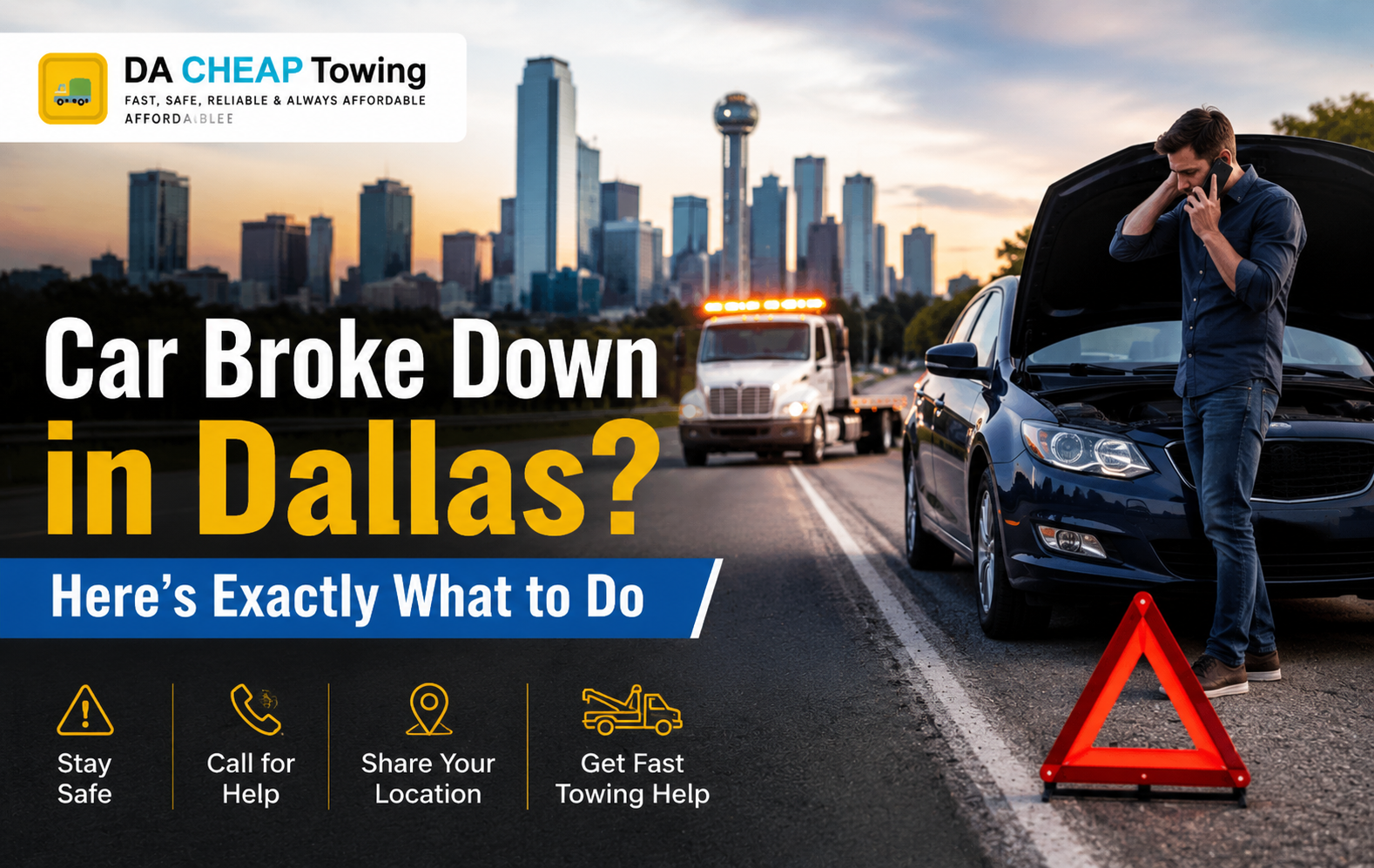
What Should You Do If Your Car Breaks Down in Dallas?
Your engine sputters, a warning light flashes, and suddenly you’re coasting to a stop on I-30 with no shoulder in sight.
Your heart’s racing, cars are flying past at 70 mph, and you have about ten seconds to make the right decision.
This is the moment most Dallas drivers never prepare for, and it’s exactly why breakdowns turn into accidents. Not because the car failed, but because of what happened in the minutes after.
This guide gives you a clear, step-by-step plan for a Dallas breakdown, on the highway, in traffic, or on a quiet side street, plus the mistakes that make a bad situation worse.
If your car breaks down in Dallas, ease off the gas without braking hard, steer to the far-right shoulder or nearest exit, turn on your hazard lights, and stay inside your buckled vehicle if you’re near moving traffic. Once safe, call 911 only if there’s injury, fire, or you’re blocking a live lane, otherwise call a licensed towing Dallas company or your roadside assistance provider.
7 Essential Steps to Follow
If your car breaks down, staying calm and following the right steps can protect you and everyone around you. These seven essential actions will help you get to a safe location, remain visible to other drivers, contact the right assistance, and avoid common mistakes that could make the situation more dangerous or more expensive.
Step 1: Don’t Panic — Coast, Don’t Brake Hard
The moment you feel your car losing power, resist the urge to slam the brakes. Ease off the accelerator and let the car coast while you signal and steer gradually toward the right shoulder, an exit ramp, or the nearest side street. Sudden braking on a highway increases the chance of being rear-ended by traffic that isn’t expecting you to stop.
If you’re on a multi-lane highway like I-635, US-75, or the Dallas North Tollway, aim for the nearest exit if you have enough momentum. Getting off the highway entirely is always safer than stopping on a shoulder.
Step 2: Get as Far Off the Road as Physically Possible
Once you’ve lost momentum, park as far right as the road allows — full shoulder, frontage road, parking lot, or side street. If you’re on a hill or slope, turn your wheels away from the road and engage the parking brake so the car can’t roll into traffic.
Avoid stopping on a curve, near an overpass, or anywhere sightlines are limited. Drivers need time to see you and react.
Step 3: Make Yourself Impossible to Miss
Turn your hazard lights on immediately — before you even check what’s wrong. At night, leave your interior lights on too. If you carry flares or reflective triangles, place them well behind your vehicle, giving approaching traffic enough distance to slow down safely.
Step 4: Decide — Stay In, or Get Out?
This decision depends entirely on where you’ve stopped.
If you’re still partially in a lane, or traffic is heavy and fast, stay inside your vehicle with your seatbelt on and doors locked. Most roadside injuries happen when people exit into moving traffic, not from the breakdown itself.
If you’ve made it safely to a shoulder, frontage road, or parking lot, it’s usually fine to exit — but do it from the passenger side, away from traffic, and move well clear of the vehicle rather than standing right next to it.
Step 5: Call the Right Number — Not Just Any Number
Not every breakdown needs 911. Here’s how to decide:
Call 911 immediately if anyone is injured, there’s smoke or fire, a fluid leak poses a hazard, or your car is stuck in a live travel lane with no way to move it.
Call towing Dallas or roadside assistance if everyone’s safe, the car is off the roadway, and you simply need a tow, jump-start, or fuel delivery.
When you call, be ready to give:
- Your exact location (nearest exit, mile marker, or cross streets)
- Vehicle make, model, and color
- A brief description of the issue
Step 6: Protect Yourself From Scam Tow Operators
One thing many drivers don’t expect: unlicensed operators sometimes monitor traffic apps or scanners and show up before your actual tow arrives, offering vague pricing and pressure tactics.
Before anyone touches your car, confirm the driver can verify the company name and that you (or your insurance provider) actually requested them. If a truck shows up uninvited, it’s completely fine to decline and wait for the service you called.
Step 7: Stay Safe and Comfortable While You Wait
Texas heat is its own hazard. If your engine’s off and it’s a hot day, crack the windows for airflow and stay hydrated rather than running the AC on a dead or overheating engine. At night or in an unfamiliar area, keep your doors locked, and if a stranger offers help, crack the window slightly rather than opening the door — ask them to call for assistance if you’re unsure.
Use the wait productively: gather your ID, insurance card, and registration, and take a few photos of your vehicle’s position for insurance purposes.
5 Common Mistakes That Make Breakdowns Worse
- Braking hard instead of coasting — increases rear-end collision risk
- Standing behind the vehicle — the most common cause of roadside injuries
- Accepting help from an unrequested tow truck — often leads to inflated charges
- Ignoring the parking brake on a slope — the vehicle can roll into traffic
- Waiting outside in extreme heat without hydration — a real risk during Texas summers
FAQs: Car Breakdowns in Dallas
Should I call 911 or roadside assistance first if my car breaks down?
Call 911 only if there’s injury, fire, a hazardous leak, or your vehicle is stuck in a live lane. For everything else, call towing Dallas or your roadside assistance provider directly.
Is it safe to stay inside my car on a Dallas highway shoulder?
Yes — in most cases, staying buckled inside is safer than standing near moving traffic, unless there’s smoke, fire, or a strong fuel smell.
How do I know if a tow truck that shows up is legitimate?
Confirm the company name matches who you or your insurance provider contacted. If you didn’t call them, it’s fine to decline and wait for your requested service.
What information should I have ready when calling for a tow?
Your exact location, vehicle make/model/color, and a short description of the issue — this speeds up dispatch significantly on DFW’s large highway network.
What if my car breaks down at night in an unfamiliar Dallas neighborhood?
Stay inside with doors locked, keep hazard lights on, and call for help immediately. Avoid walking to a gas station unless it’s very close and clearly safe.
The Bottom Line
A breakdown in Dallas doesn’t have to spiral into a dangerous situation. Coast instead of braking hard, get as far off the road as possible, stay visible, and make the smart call — literally — about who you let near your vehicle. Having a reliable towing Dallas contact saved in your phone before you ever need one is the single best thing you can do to turn a stressful moment into a controlled one.