
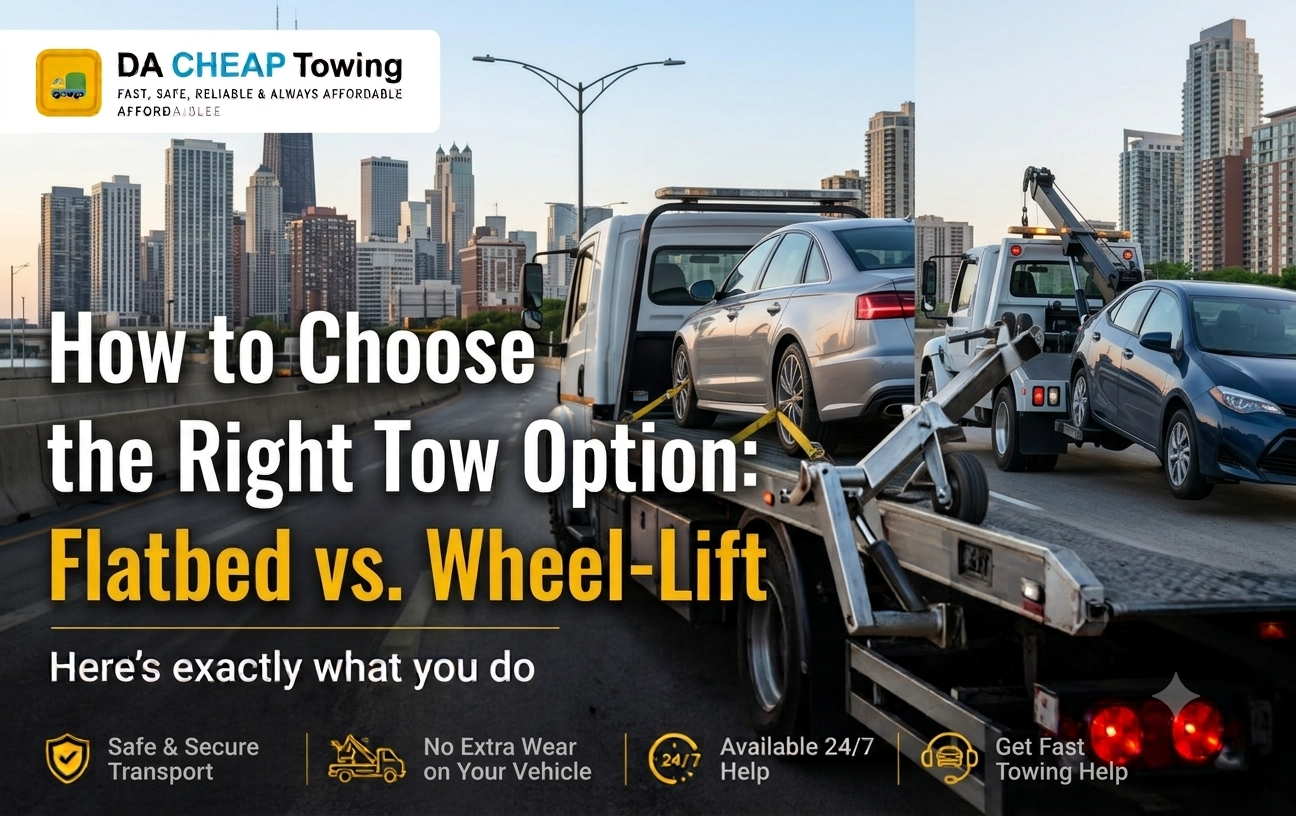
When you call for a tow, there’s a good chance the dispatcher will ask a question you weren’t expecting: “Do you need a flatbed or wheel-lift?” If you’ve never thought about how a tow truck actually works, that question can be confusing at the worst possible time.
Here’s what matters: these two methods aren’t interchangeable, and the right choice depends on your specific vehicle, not personal preference.
Flatbed towing loads your entire vehicle onto a flat platform so all four wheels are off the ground, making it the safest option for all-wheel-drive vehicles, low-clearance cars, non-running vehicles, and long-distance transport.
Wheel-lift towing raises one end of the vehicle while the other two wheels roll on the road, making it a faster, more cost-effective option for standard front-wheel or rear-wheel-drive vehicles going a short distance. Neither method is universally “better” — the right choice depends on your vehicle’s drivetrain, condition, and how far it’s going.
How Flatbed Towing Works
A flatbed tow truck has a long, hydraulic platform built into the back of the truck. When it arrives, the bed tilts down to ground level, your vehicle is either driven or winched onto it, and the platform is raised back to a level position.
Once loaded, your car is secured with straps or chains at multiple points, and none of it touches the road during transport.
Because the vehicle never rolls, there’s no mechanical stress on the tires, transmission, or drivetrain, which is exactly why flatbed towing is considered the gold standard for vehicle protection.
Flatbed towing is the right call when:
- Your vehicle is all-wheel drive or four-wheel drive
- Your car won’t start or can’t move under its own power
- You drive a low-clearance, lowered, or sports car
- Your vehicle was in an accident and may have wheel, suspension, or steering damage
- You’re transporting a luxury, classic, or high-value vehicle
- The tow is a long-distance or interstate move
- You drive an electric vehicle, where towing with wheels rolling can damage the motor or battery system
Learn More – Flatbed Towing Service
How Wheel-Lift Towing Works
A wheel-lift tow truck uses a hydraulic metal yoke that slides under either the front or rear tires. The yoke lifts that end of the vehicle off the ground, while the other two wheels stay on the road and roll freely as the truck drives. Whether the front or rear end is lifted depends on the vehicle’s drivetrain.
This method is faster to set up than flatbed towing and uses smaller, more maneuverable trucks — which makes it a practical option in tight parking garages, narrow streets, or busy urban areas.
Wheel-lift towing works well when:
- Your vehicle is a standard front-wheel or rear-wheel-drive car in drivable condition
- The tow distance is short — across town rather than across the state
- You’re in a tight space where a smaller truck can maneuver more easily
- Time matters, since wheel-lift hookups are typically quicker than flatbed loading
Flatbed vs Wheel-Lift: Side-by-Side Comparison
- Vehicle protection: Flatbed towing offers maximum protection since no part of the car touches the road. Wheel-lift towing is generally safe for standard vehicles in good condition, but carries more risk for AWD, low-clearance, or already-damaged vehicles.
- Cost: Wheel-lift towing is typically less expensive due to simpler, faster equipment. Flatbed towing costs somewhat more, reflecting the larger truck and extra loading time.
- Speed of hookup: Wheel-lift trucks connect faster, which matters for quick roadside recoveries. Flatbed loading takes a few extra minutes but delivers a more secure, stable ride.
- Maneuverability: Wheel-lift trucks are smaller and better suited to tight parking structures and narrow streets. Flatbed trucks need more space to position and load.
- Distance suitability: Wheel-lift towing is best suited to short, local tows. Flatbed towing is the safer, more stable option for long-distance or interstate transport.
- Vehicle compatibility: Wheel-lift towing is designed for standard 2WD vehicles. Flatbed towing works for virtually any vehicle, including AWD, 4WD, non-running, and low-clearance cars.
Why the Wrong Method Can Cost You More Than Money
This isn’t just a matter of preference. Towing an all-wheel-drive vehicle with a wheel-lift truck can force the drivetrain to engage while the engine is off, which can cause serious and expensive damage to the transfer case or transmission, sometimes without any obvious sign until days later.
Similarly, a vehicle with accident damage to its wheels, suspension, or steering components can suffer additional harm if it’s forced to roll during a wheel-lift tow, since damaged parts weren’t designed to bear that stress.
This is exactly why a good towing company asks about your vehicle’s make, model, drivetrain, and condition before dispatching a truck, not because it’s a formality, but because it determines what shows up.
How to Know Which One Your Vehicle Needs
- Check your owner’s manual — many manufacturers specify flatbed-only towing for AWD and 4WD models
- If your car is a standard 2WD sedan or SUV in drivable condition and going a short distance, wheel-lift is usually fine
- If your car won’t start, was in an accident, or is AWD/4WD, ask specifically for flatbed towing
- When in doubt, tell the dispatcher your exact make, model, and drivetrain — they’ll recommend the right method for you
FAQs: Flatbed vs Wheel-Lift Towing
Which is safer, flatbed or wheel-lift towing?
Flatbed towing is generally considered safer for vehicle protection since no part of the car touches the road. Wheel-lift towing is safe for most standard, undamaged 2WD vehicles over short distances.
Can my AWD car be towed with a wheel-lift truck?
In most cases, no. AWD and 4WD vehicles should be flatbed towed to avoid damaging the drivetrain, since wheel-lift towing leaves two wheels rolling on the ground.
Is flatbed towing more expensive than wheel-lift towing?
Generally, yes, due to the larger truck and extra loading time involved. However, for vehicles that require flatbed transport, the cost difference is worth avoiding potential drivetrain or suspension damage.
How do I know which towing method my car needs?
Check your owner’s manual for towing instructions, or simply tell the dispatcher your car’s make, model, and drivetrain when you call — they’ll determine the safest method for your specific vehicle.
Can a wheel-lift tow truck damage my car?
When used on the vehicle type it’s designed for — a standard, undamaged 2WD car — wheel-lift towing is safe. Damage risk increases significantly when it’s used on AWD, 4WD, or already-damaged vehicles.
The Bottom Line
Flatbed and wheel-lift towing both have a place — the real question isn’t which method is universally better, but which one is right for your specific vehicle, its condition, and how far it needs to go. Knowing this before you’re stranded means you can ask for the right service the moment you call, instead of hoping the dispatcher figures it out for you.
Wherever you’re stranded across Dallas–Fort Worth, DA Cheap Towing Company dispatches the correct method, flatbed or wheel-lift, based on your vehicle’s actual needs, not guesswork, so your car arrives exactly the way it left.