
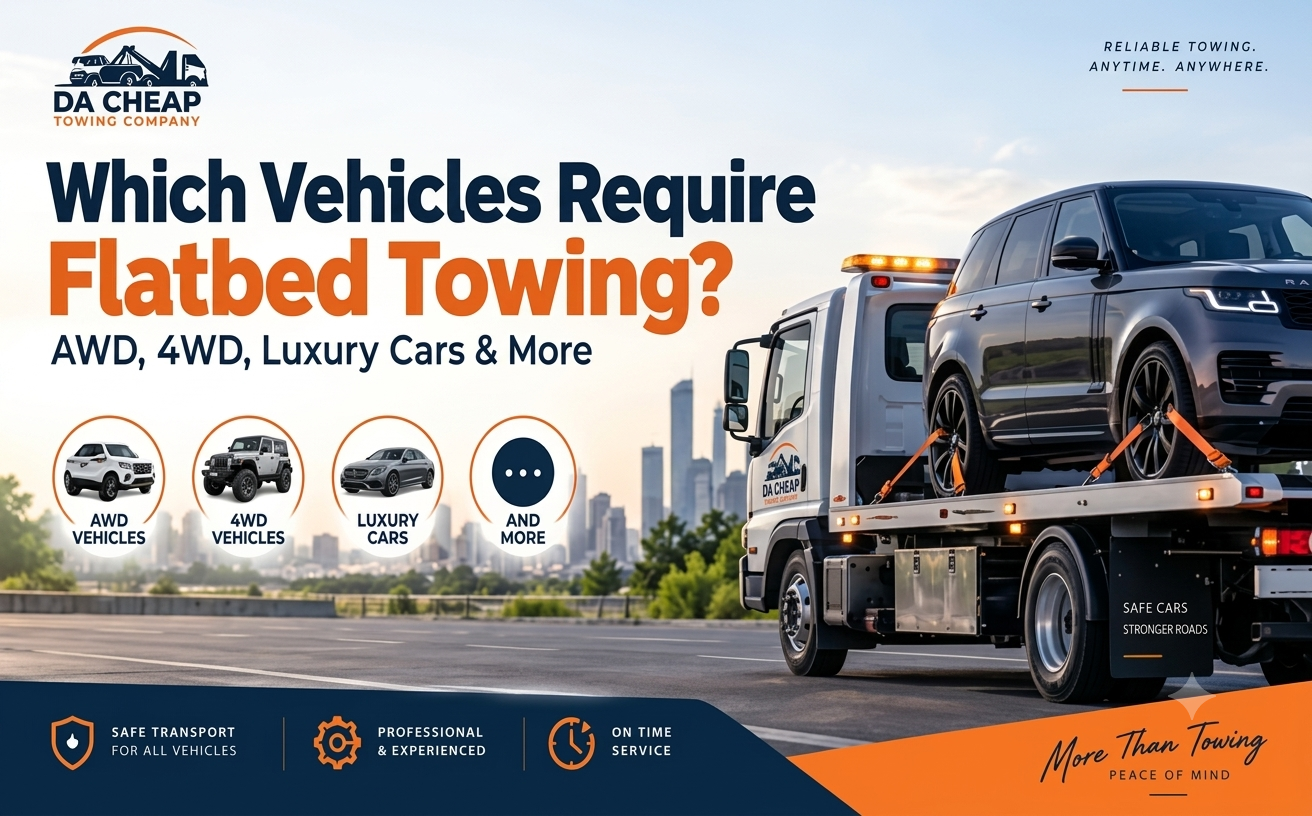
Not every vehicle needs a flatbed tow truck. For many standard cars, a wheel-lift tow can be perfectly suitable. But some vehicles should be transported with all four wheels off the road to reduce the risk of drivetrain, tire, suspension, or body damage.
So, which vehicles require flatbed towing?
In general, flatbed towing is particularly useful for AWD and 4WD vehicles, luxury and exotic cars, low-clearance vehicles, motorcycles, non-running vehicles, accident-damaged vehicles, and vehicles that need longer-distance transportation. The exact towing method can depend on the vehicle manufacturer’s recommendations, its condition, and the reason it needs to be moved.
Understanding these differences can help you request the right equipment when your vehicle breaks down or needs transportation.
What Is Flatbed Towing?
Flatbed towing uses a tow truck with a long, level platform. Instead of leaving two wheels on the road, the entire vehicle is loaded onto the platform and secured for transportation.
This means all four wheels remain off the ground while the vehicle is being transported.
That difference is important because some vehicles cannot safely have their wheels rolling during a tow.
DA Cheap Towing Company describes its flatbed service as a transportation option for AWD and 4WD vehicles, luxury cars, electric vehicles, motorcycles, low-clearance vehicles, classic cars, and other vehicles requiring additional protection.
Which Vehicles Need Flatbed Towing?
There isn’t one rule that applies to every vehicle. However, several types commonly benefit from or require flatbed transportation.
1. AWD Vehicles
AWD towing requires particular attention because all four wheels can be connected to the vehicle’s drivetrain.
With some AWD systems, allowing two wheels to roll while the other two are lifted can create unwanted drivetrain movement. Depending on the vehicle, this may cause damage to the transmission, transfer case, or other drivetrain components.
That’s why many AWD vehicles should be transported on a flatbed.
If you’re not sure about your particular AWD system, check the owner’s manual or tell the towing dispatcher the exact make and model.
For a disabled AWD vehicle, asking specifically for flatbed towing can help avoid sending equipment that isn’t appropriate for the drivetrain.
2. 4WD Vehicles
Four-wheel-drive vehicles can have similar towing considerations.
Pickup trucks and SUVs with 4WD systems are often heavier than standard passenger cars, and their drivetrain configuration may make wheel-lift towing unsuitable.
A flatbed keeps all four wheels off the road during transport.
This is particularly useful when the vehicle has suffered a mechanical failure and cannot be driven normally.
3. Luxury and Exotic Cars
A standard vehicle may tolerate normal towing equipment without a problem, but owners of high-value vehicles often want to minimize unnecessary contact with the road.
This is where luxury car towing becomes a different consideration.
Luxury and exotic vehicles may have:
- Low ground clearance
- Large or specialized wheels
- Sensitive body panels
- Performance suspension systems
- Expensive tires
- Specialized drivetrain configurations
A flatbed allows the entire vehicle to be transported without the tires rolling on the road.
For a high-value vehicle, that extra level of protection can be particularly important.
4. Low-Clearance Sports Cars
Lowered cars and sports cars can present another challenge.
The front bumper, splitter, side skirts, exhaust, or underbody may sit very close to the ground. Loading the vehicle onto unsuitable equipment can create clearance problems.
A flatbed can make loading easier because the platform can be positioned closer to the ground before the vehicle is winched or driven onto it.
This is especially relevant for modified vehicles with aftermarket suspension or body kits.
5. Electric Vehicles
Electric vehicles can have specific towing requirements depending on their design.
Because an EV may have electric motors connected to the wheels, manufacturers can specify particular transportation procedures when the vehicle is disabled.
If an electric vehicle cannot be safely driven, check the manufacturer’s towing instructions and tell the towing company that it is an EV.
A flatbed can be a practical option because the entire vehicle is lifted off the road rather than relying on the driven wheels to roll during transportation.
6. Motorcycles
Motorcycles are another vehicle type that often calls for specialized flatbed equipment.
A motorcycle is fundamentally different from a four-wheel vehicle. It needs to remain upright and securely positioned throughout transportation.
Specialized motorcycle towing equipment can include wheel cradles, straps, and other methods designed to secure the bike without damaging its components.
A regular wheel-lift tow truck isn’t automatically appropriate just because the motorcycle is relatively light.
7. Non-Running Vehicles
If your vehicle won’t start, flatbed towing can make the loading process easier.
A non-running vehicle cannot simply be driven onto the tow truck. It may need to be winched onto the platform.
This can be particularly useful when the vehicle has:
- A dead battery
- Engine failure
- Transmission failure
- Electrical problems
- Severe mechanical damage
- A locked drivetrain
- Accident-related damage
The vehicle’s condition should be explained to the dispatcher before the truck is sent.
8. Accident-Damaged Vehicles
A vehicle involved in an accident may look towable but still have hidden damage.
The steering, suspension, wheels, tires, frame, or drivetrain could be affected.
If the vehicle cannot safely roll or steer, a flatbed may be more appropriate than a wheel-lift truck.
For example, if one wheel is badly damaged, lifting the opposite end and allowing the damaged wheel to roll could create additional problems.
In these situations, the towing method should be selected based on the vehicle’s actual condition.
9. Classic and Collector Cars
Classic cars can have older components, specialty tires, low-clearance designs, or valuable original parts.
Owners may want to avoid unnecessary road contact and minimize the chance of cosmetic or mechanical damage during transportation.
A flatbed keeps the vehicle completely off the roadway and allows it to be secured on a stable platform.
DA Cheap Towing Company lists classic and collector vehicles among the types that can be transported using its flatbed service.
Flatbed vs. Wheel-Lift: Which Vehicles Fit Each Method?
The difference becomes easier to understand when you compare the two approaches.
| Vehicle or Situation | Flatbed | Wheel-Lift |
| Standard 2WD car | Suitable | Often suitable |
| AWD vehicle | Usually preferred | May be unsuitable |
| 4WD vehicle | Usually preferred | May be unsuitable |
| Luxury car | Preferred | Depends on vehicle |
| Low-clearance sports car | Preferred | May create clearance issues |
| Motorcycle | Specialized flatbed preferred | Generally unsuitable |
| Non-running vehicle | Often preferred | Depends on condition |
| Accident-damaged vehicle | Often preferred | Depends on damage |
| Classic car | Often preferred | Depends on vehicle |
| Long-distance transport | Often preferred | Depends on vehicle |
The table is a general guide, not a substitute for the vehicle manufacturer’s towing instructions.
Does Every Car Need Flatbed Towing?
No.
This is an important distinction.
A flatbed is not automatically required just because a vehicle needs a tow. Many standard front-wheel-drive or rear-wheel-drive vehicles can be safely transported using a wheel-lift tow truck when the vehicle is in suitable condition and the towing method follows the manufacturer’s recommendations.
For example, a normally functioning 2WD sedan that needs a short local tow may not require a flatbed.
The important question is:
What type of vehicle is it, and what condition is it in?
What About AWD Towing?
AWD is one of the biggest reasons drivers should ask about towing equipment before the truck arrives.
Don’t simply say, “I need a tow.”
Tell the dispatcher:
“I have an AWD vehicle that won’t start.”
That immediately gives the towing company important information about the drivetrain and equipment requirements.
The same applies to 4WD vehicles.
If you know the make, model, year, and drivetrain, provide those details when requesting service.
Does Distance Matter?
Distance can also influence the choice of towing method.
For a short local tow, some standard vehicles can be transported with a wheel-lift. For longer trips, keeping all four wheels off the road can provide an additional level of protection and eliminate rolling wear during transportation.
DA Cheap Towing Company lists both local and long-distance flatbed transportation among its services across the DFW area.
However, the vehicle itself remains the primary consideration.
What Should You Tell the Tow Company?
When requesting a flatbed towing service, give the dispatcher enough information to identify the correct equipment.
Tell them:
- Vehicle year, make, and model
- AWD, 4WD, FWD, or RWD
- Whether the vehicle starts
- Whether the wheels can roll
- Whether there is accident damage
- Whether the vehicle has low clearance
- Exact pickup location
- Where you need it transported
This can prevent a situation where the wrong truck arrives and another unit has to be dispatched.
Frequently Asked Questions
Q. Which vehicles should be flatbed towed?
A. AWD and 4WD vehicles, luxury cars, low-clearance vehicles, motorcycles, many EVs, classic cars, non-running vehicles, and accident-damaged vehicles are common situations where flatbed towing may be appropriate.
Q. Does an AWD vehicle need flatbed towing?
A. Many AWD vehicles should be transported with all four wheels off the ground, but the exact requirement depends on the vehicle. Check the owner’s manual and provide the make and model to the towing company.
Q. Is flatbed towing safer for a luxury car?
A. A flatbed keeps all four wheels off the road, which can reduce drivetrain and rolling-related concerns. This makes it a commonly preferred option for luxury and high-value vehicles.
Q. Can a non-running car be flatbed towed?
A. Yes. A non-running vehicle can typically be winched onto the flatbed rather than driven onto it. The operator should know beforehand that the vehicle cannot move under its own power.
Q. Do electric cars need flatbed towing?
A. Some EV manufacturers specify particular towing procedures. If the vehicle is disabled, check its owner’s manual and tell the towing company that it is electric before dispatch.
Q. Is flatbed towing more expensive?
A. It can cost more than some standard towing methods because flatbed trucks use specialized equipment and require a different loading process. The actual price depends on distance, vehicle condition, equipment, and other circumstances.
Conclusion
Flatbed towing isn’t necessary for every vehicle, but certain vehicles and situations make it a particularly important option.
AWD and 4WD vehicles, luxury cars, low-clearance sports cars, motorcycles, EVs, classic vehicles, non-running cars, and accident-damaged vehicles can all have towing requirements that make keeping all four wheels off the road beneficial.
If you’re unsure, don’t guess. Give the towing company your vehicle’s make, model, drivetrain, and condition. That information allows the dispatcher to determine whether a flatbed is appropriate.
For drivers across Dallas-Fort Worth, DA Cheap Towing Company provides flatbed towing for AWD/4WD vehicles, luxury cars, EVs, motorcycles, classic cars, low-clearance vehicles, and other vehicles requiring specialized transport.