
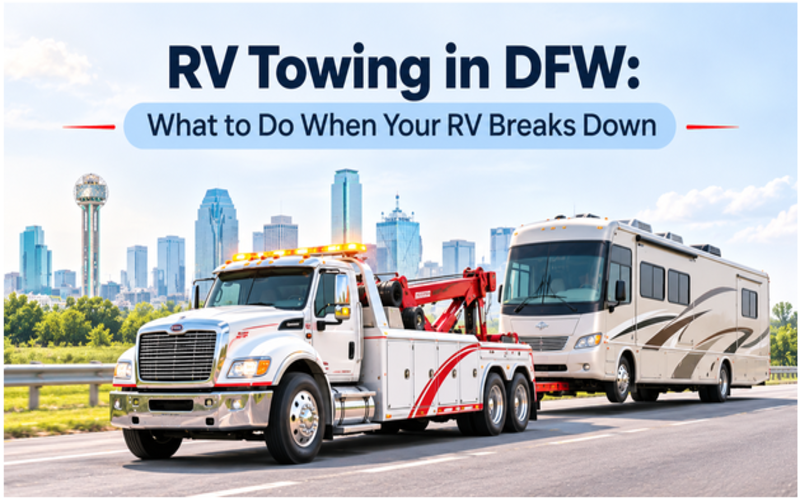
An RV breakdown feels different from a car breakdown. It’s bigger, heavier and full of your stuff. You may have family, pets or a car hitched behind you. And not every tow truck in Dallas-Fort Worth can handle it.
The good news: with the right steps and the right equipment, RV towing is routine work. Here’s what to do when your motorhome or travel trailer won’t go any farther, and how the tow actually works.
If your RV breaks down in DFW, get it as far off the road as possible, turn on your hazards and set out warning triangles. Then call an RV towing company and share the RV’s class, length, weight and location. Before the tow, retract slide-outs, raise levelers, turn off propane and unhook any towed car. Large Class A motorhomes need a heavy-duty wrecker; smaller RVs and trailers may go on a flatbed or with a properly rated tow truck.
Step 1: Get Safe First
DFW highways like I-35E, I-20 and I-30 move fast, and an RV on the shoulder takes up a lot of space.
- Pull as far off the road as you safely can, ideally onto a wide shoulder or exit ramp.
- Turn on hazard lights and set out reflective triangles behind the RV.
- Keep everyone, including pets, inside or well away from traffic.
- If you’re blocking a lane, call 911.
Step 2: Know Your RV’s Details
The dispatcher needs this information to send the right truck. Sending the wrong one wastes time and can damage your RV.
| Detail | Why it matters |
|---|---|
| RV class (A, B, C, travel trailer, fifth wheel) | Determines the tow method and truck size |
| Length and approximate weight | Heavy RVs need a heavy-duty wrecker |
| Gas or diesel | Affects how the drivetrain is handled |
| What went wrong | Helps decide if roadside repair is possible |
| Towed vehicle behind it | It must be unhooked and moved separately |
| Exact location and direction | Faster arrival |
Your RV’s weight rating is usually on a sticker near the driver’s seat or in the owner’s manual.
How RV Towing Works by RV Type
Class A motorhomes. These are the big, bus-style RVs, often 30 to 45 feet long. They usually need a heavy-duty wrecker that lifts the front end. Diesel pushers may need the driveshaft disconnected or air brakes managed during the tow. Our heavy-duty towing team is equipped for this.
Class C motorhomes. These are built on a truck chassis with a cab-over bunk. Depending on size and weight, they may be towed with a medium or heavy-duty truck.
Class B camper vans. Smaller van-based RVs can often go on a flatbed, which is the safest option.
Travel trailers and fifth wheels. If your tow vehicle breaks down, the trailer can often be hitched to a properly equipped truck and moved. See our trailer towing service.
Step 3: Prep Your RV for the Tow
A few minutes of prep makes the tow safer and prevents damage:
- Retract all slide-outs and secure the awning.
- Raise leveling jacks and stabilizers.
- Turn off propane at the tank.
- Secure loose items inside: cabinets, fridge doors and anything on counters.
- Unhook your towed car, if you have one.
- Close all windows, vents and roof hatches.
- Take valuables, medication and pets with you.
If a slide-out won’t retract because of an electrical or hydraulic problem, tell the dispatcher right away. It changes how the RV can be moved.
Can the RV Be Fixed Without a Tow?
Sometimes. A dead chassis battery, a flat tire or running out of fuel may be handled with roadside assistance. But RV tires are large and heavy, and many problems, like engine, transmission or brake failures, need a shop.
If you’re not sure, describe the symptoms when you call. We’ll tell you honestly whether a tow is needed.
Where Should Your RV Go?
Not every repair shop can fit or fix an RV. Before the tow, call ahead to make sure your destination:
- Works on your RV type and chassis (Ford, Freightliner, Spartan and others)
- Has room to park it
- Is open or can accept an after-hours drop-off
If you’re staying nearby, an RV park or storage lot can also be a short-term destination.
Can I Ride in the RV During the Tow?
No. For safety, no one should ride inside an RV while it’s being towed. Ask the tow company whether you can ride in the tow truck, or arrange separate transport.
How Much Does RV Towing Cost?
RV towing costs more than car towing because it needs bigger trucks and more time. The price depends on the RV size and weight, distance, location and time of day. At DA Cheap Towing, you’ll get a flat rate before we dispatch. For a general look at towing prices, see our Dallas towing cost guide.
Also check your RV insurance. Many RV policies include towing coverage. Our guide on whether insurance covers towing can help.
24/7 RV Towing Across DFW
DA Cheap Towing provides RV and motorhome towing for Class A, B and C motorhomes, travel trailers and fifth wheels across Dallas, Plano, Irving, McKinney, Richardson and Farmers Branch.
Call (214) 206-4521 or get a free quote.
Frequently Asked Questions
What kind of tow truck is needed to tow an RV?
Large Class A motorhomes usually need a heavy-duty wrecker. Smaller Class B vans may fit on a flatbed. Class C RVs depend on size and weight.
Can you tow an RV with the slide-outs extended?
No. Slides should be retracted before towing. If one won’t retract, tell the dispatcher so the crew can plan for it.
Can I ride inside my RV while it’s towed?
No. It isn’t safe for anyone to ride inside a towed RV.
Does RV insurance cover towing?
Many RV policies include towing or roadside coverage. Check your policy or call your insurer.
Do you tow travel trailers and fifth wheels?
Yes. DA Cheap Towing tows travel trailers, fifth wheels and motorhomes across DFW.