
Flatbed Towing Explained: When Your Vehicle Needs It
If your car has ever needed a tow, you’ve probably heard the term “flatbed towing” thrown around — but most drivers don’t actually know what it means, why it costs more, or whether it’s the right choice for their situation. That gap in knowledge matters, because choosing the wrong towing method can genuinely damage your vehicle, sometimes in ways that show up weeks later.
This guide breaks down exactly what flatbed towing is, how it compares to older methods, and the specific situations where it isn’t optional — it’s the only safe choice.
Flatbed towing is a method where your entire vehicle is lifted and secured onto a flat, level trailer bed, so all four wheels are off the ground during transport. It’s the safest towing method available and is required for inoperable vehicles, all-wheel drive cars, low-clearance vehicles, motorcycles, and long-distance moves, because it eliminates the wear, rolling stress, and damage risk that come with other towing methods.
How Flatbed Towing Actually Works
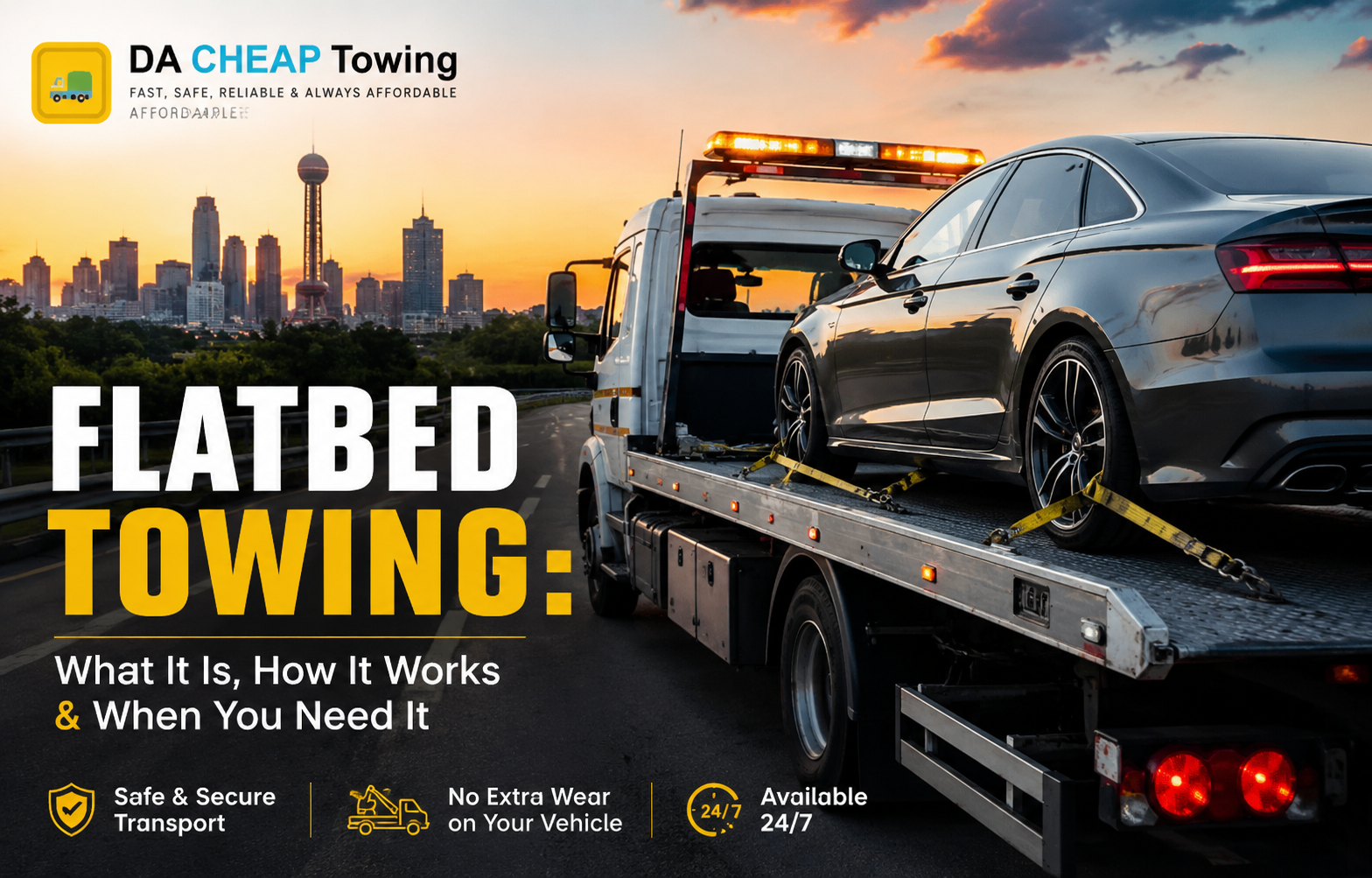
A flatbed tow truck has a hydraulic platform built into the back of the truck bed. When it arrives, the bed tilts down to ground level, the vehicle is winched or driven onto it, and the platform is raised back to a level, horizontal position. Your car is then strapped down at multiple points and transported without any part of it touching the road.
Because none of the wheels are rolling and no part of the drivetrain is engaged during transport, there’s essentially zero mechanical stress placed on the vehicle — which is the core advantage over older towing methods.
Flatbed vs. Hook-and-Chain: What’s the Real Difference
Hook-and-chain towing is the older method most people picture when they think of a “tow truck” — chains hook onto the frame or axle, lifting one end of the car while the other two wheels stay on the road and roll along behind.
It’s faster to hook up and generally cheaper, which is why it’s still used for short local tows or vehicles headed straight to a scrapyard. But it comes with real downsides: the rolling wheels put wear on tires and can strain the transmission, and the chains themselves can scratch or dent the vehicle’s frame or bumper.
Flatbed towing solves all of that by removing the vehicle from the road entirely. It costs more because it requires specialized equipment and a larger truck, and it may take slightly longer to arrive in some areas — but for a growing number of situations, it’s not really a matter of preference. It’s a necessity.
When Flatbed Towing Is the Only Safe Option
Your vehicle is inoperable. If the engine won’t start or the car can’t move under its own power, there’s no other way to transport it without risking further mechanical damage.
You drive an all-wheel or four-wheel drive vehicle. Towing an AWD or 4WD car with only two wheels on the ground can force the drivetrain to engage while the engine is off, sometimes causing serious transmission damage. Flatbed towing avoids this entirely.
Your car has low ground clearance. Sports cars, lowered vehicles, and cars with aftermarket body kits risk scraping the undercarriage, spoiler, or splitter on a ramp-style tow. A flatbed keeps the whole vehicle level and clear of the ground.
You’re transporting a motorcycle. Motorcycles have no way to stay balanced during a hook-and-chain tow. Flatbed transport with proper strapping is the only realistic option.
Your vehicle was in an accident. A car with existing structural or suspension damage can suffer additional harm if its wheels are forced to roll during a tow. Flatbed transport keeps the vehicle stable and prevents the damage from worsening.
You need a long-distance tow. For any tow beyond a short local trip, the accumulated wear from rolling wheels adds up fast. Flatbed transport is the standard for interstate or long-distance vehicle moves.
You own a classic, luxury, or high-value vehicle. When a car’s parts and finish are difficult or expensive to replace, flatbed towing is the low-risk choice that protects the investment.
What to Expect When You Book a Flatbed Tow
- Response time: Slightly longer than a standard tow in some cases, since fewer flatbed trucks may be on the road at a given moment
- Cost: Generally higher than hook-and-chain towing, reflecting the specialized equipment and extra time to load and secure the vehicle
- Loading process: The truck bed tilts to ground level, your vehicle is winched or driven on, then leveled and strapped at multiple points before transport
- Vehicle condition on arrival: No rolling wear, no drivetrain engagement, and no risk of undercarriage scraping — the vehicle arrives in the same mechanical condition it left in
Common Mistakes Drivers Make With Towing Method Choice
- Assuming any tow truck can handle any vehicle — AWD and low-clearance cars need flatbed transport specifically, not whatever truck arrives first
- Choosing hook-and-chain to save money on an inoperable vehicle — this can cause damage that costs far more to repair than the price difference
- Not mentioning vehicle type when booking — always tell the dispatcher if your car is AWD, lowered, a motorcycle, or currently inoperable so the right truck is sent
- Assuming flatbed towing is only for long distances — it’s equally important for short local tows involving sensitive or damaged vehicles
FAQs: Flatbed Towing
Q. Is flatbed towing more expensive than regular towing?
A. Yes, typically. It requires specialized equipment and more time to load and secure the vehicle, but it eliminates the risk of drivetrain or undercarriage damage that cheaper methods can cause.
Q. Can any vehicle be flatbed towed?
A. Yes — flatbed towing works for virtually any vehicle, including inoperable cars, motorcycles, AWD vehicles, and classic cars. It’s the most universally safe towing method available.
Q. Do I need flatbed towing for a short local tow?
A. If your vehicle is AWD, low-clearance, inoperable, or accident-damaged, yes — distance doesn’t change the mechanical risk. For a standard operable vehicle going a short distance, hook-and-chain may be sufficient.
Q. Will flatbed towing damage my car in any way?
A. No — since your vehicle never touches the road during transport, flatbed towing carries the lowest damage risk of any towing method when done correctly with proper strapping.
Q. How do I know if my car needs a flatbed tow truck?
A. If your car won’t start, has all-wheel drive, sits low to the ground, was in an accident, or is a motorcycle or high-value vehicle, request flatbed towing specifically when you call.
The Bottom Line
Flatbed towing isn’t just the “premium” towing option — for a large number of everyday situations, it’s the only method that won’t put your vehicle at further risk. Knowing when to specifically request it, rather than accepting whatever truck shows up first, can be the difference between a routine tow and an expensive repair bill down the line.
If you’re dealing with a breakdown, accident, or need to move an AWD, low-clearance, or inoperable vehicle anywhere in the Dallas–Fort Worth area, DA Cheap Towing Company dispatches flatbed-equipped trucks that handle your vehicle the right way — no guesswork, no unnecessary risk.