
A semi-truck breakdown isn’t like a car breakdown. A fully loaded rig can weigh up to 80,000 pounds, block multiple lanes, and require far more than a standard tow truck backing up with a hook. If you’ve never dealt with a commercial truck breakdown before, the process can feel like a mystery at exactly the moment you need clear answers.
This guide walks through exactly how heavy-duty truck towing works, from the first call to the truck being safely transported, so you know what to expect if you’re ever standing on the shoulder next to a disabled rig.
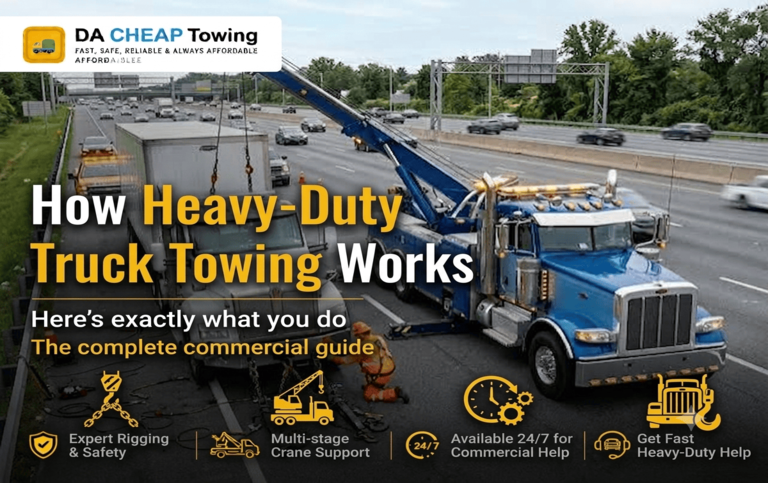
Heavy-duty truck towing uses specialized wreckers — built with high-capacity hydraulic booms, reinforced wheel lifts, and powerful winches, to safely move semi-trucks, buses, RVs, and other commercial vehicles typically weighing over 26,000 pounds.
The process starts with a scene assessment, followed by stabilizing and rigging the vehicle, then either towing it directly or performing a full recovery if it’s overturned, jackknifed, or stuck off the roadway.
What Makes Heavy-Duty Towing Different
A standard tow truck is built around the weight and dimensions of passenger vehicles, generally under 10,000 pounds. A loaded semi-truck can weigh eight times that. Attempting to move it with undersized equipment doesn’t just fail; it risks serious damage to the truck, injury to the crew, and additional hazards for everyone on the road nearby.
Heavy-duty tow trucks, often called wreckers, are purpose-built for this. They’re equipped with high-capacity hydraulic booms, commonly rated between 25 and 50 tons, reinforced wheel-lift systems, air brake systems matched to the load, and industrial winches for pulling vehicles out of ditches, mud, or jackknifed positions. Many also feature rotating booms, known as rotators, which can pivot 360 degrees to lift or pull from difficult angles after a rollover.
The Heavy-Duty Towing Process, Step by Step
1. Scene Assessment
Before any equipment touches the vehicle, an experienced operator surveys the scene: the truck’s position, the condition of the ground beneath it, weight distribution, whether cargo has shifted, and proximity to traffic. This step shapes the entire recovery plan — a jackknifed trailer on a highway median requires a completely different approach than a truck that’s gone off a ramp or rolled onto its side.
2. Safety and Traffic Control
Because a disabled commercial vehicle often blocks lanes or creates a hazard, the crew positions service trucks to create a buffer zone and may coordinate with local authorities for traffic control. Getting this right protects both the recovery team and everyone else on the road while the work is underway.
3. Stabilizing the Vehicle
If the truck is upright and simply disabled, this step is straightforward. If it’s overturned or jackknifed, the crew uses tools like air cushions, stabilizing outriggers, or a rotator to carefully upright it in controlled stages — avoiding further damage to the cab, trailer, or cargo.
4. Rigging and Securing
Once stable, the truck is connected to the wrecker using heavy-duty chains, straps, and J-hooks attached to the frame rails and axles, with an underlift typically raising the front axle. For long-distance moves or more severe damage, the truck may instead be loaded onto a flatbed trailer for full transport.
5. Winching or Uprighting, If Needed
For trucks stuck in mud, ditches, or off the roadway entirely, the crew uses winch lines and tools like snatch blocks to pull the vehicle back to solid ground in a controlled, gradual motion — never a single forceful yank, which risks damaging the frame or drivetrain.
6. Transport
With everything secured, the truck is towed or transported to a repair facility, yard, or other destination. Depending on the complexity of the recovery, the entire process — from arrival to departure — typically takes anywhere from 30 minutes for a straightforward breakdown to several hours for a complex accident recovery.
Common Situations That Require Heavy-Duty Towing
- Engine, transmission, or brake failure that leaves the truck unable to move
- Accidents involving a semi, bus, RV, or other commercial vehicle
- Jackknifed trailers on the highway
- Trucks stuck in mud, soft shoulders, or off-road terrain
- Overturned or rolled commercial vehicles requiring uprighting before transport
- Scheduled transport of commercial trucks, RVs, or heavy equipment
What Equipment Is Actually Used
Rotators are the most versatile tool in heavy-duty recovery, a rotating boom capable of lifting and repositioning a truck from nearly any angle, especially useful for overturned vehicles or awkward positions in ditches. Standard heavy wreckers use a fixed boom and underlift, suited for straightforward tows of trucks that are upright and stable.
Air cushion recovery systems lift overturned vehicles evenly without causing additional structural damage. Winches and snatch blocks provide the controlled pulling power needed to free a stuck or jackknifed vehicle without a dangerous, sudden jolt.
What to Do If Your Truck Breaks Down
- Get as far off the travel lanes as possible and turn on hazard lights immediately
- Set out reflective triangles or flares behind the vehicle if it’s safe to do so
- Call for heavy-duty towing specifically — a standard tow truck cannot handle a commercial vehicle
- Provide your exact location, truck type, approximate weight, and whether it’s loaded or empty
- Stay in a safe location away from live traffic while you wait for the crew to arrive
FAQs: Heavy-Duty Truck Towing
How long does heavy-duty truck towing take?
A straightforward breakdown tow typically takes around 30 minutes to an hour once the crew arrives. Complex recoveries involving an overturned or jackknifed truck can take several hours, depending on the situation.
What’s the difference between towing and recovery for a truck?
Towing moves a vehicle that’s upright and accessible on a roadway. Recovery involves more complex situations — overturned trucks, vehicles stuck off-road, or jackknifed trailers — requiring specialized equipment and a more involved process.
Can a regular tow truck move a semi-truck?
No. Standard tow trucks are built for vehicles under roughly 10,000 pounds. A loaded semi can weigh up to 80,000 pounds and requires a heavy-duty wrecker with the appropriate boom capacity and rigging equipment.
What information should I give when calling for heavy-duty towing?
Your exact location, the type of truck, whether it’s loaded or empty, and a description of the situation — mechanical breakdown, accident, or stuck off-road — so the right equipment and crew size are dispatched.
Do heavy-duty tow operators need special certification?
Yes, in most cases. Operating heavy-duty recovery equipment typically requires specialized training, and many professional operators hold certifications such as WreckMaster to demonstrate safe recovery techniques.
The Bottom Line
Heavy-duty truck towing is a fundamentally different operation from towing a passenger car — different equipment, different training, and a process built around managing serious weight and real roadway risk. Knowing what to expect, and what information to have ready when you call, helps get the right crew and equipment to you faster.
If a semi-truck, box truck, or other commercial vehicle has broken down anywhere across Dallas–Fort Worth, DA Cheap Towing Company’s heavy-duty towing team responds with the properly rated equipment to recover and transport your vehicle safely, the first time.