
When your car breaks down, your first thought is probably simple: “I need a tow truck.”
But there is another question worth asking before a truck is dispatched: What type of tow truck does my vehicle need?
Not every vehicle should be transported the same way. A wheel-lift truck may work perfectly well for some towing jobs, while other situations call for a flatbed tow truck to reduce the risk of damage.
A flatbed carries the entire vehicle on a platform, keeping all four wheels off the road during transportation. That can make a major difference when you are dealing with collision damage, certain AWD or 4WD vehicles, low ground clearance, serious mechanical problems, or a vehicle that simply needs extra protection.
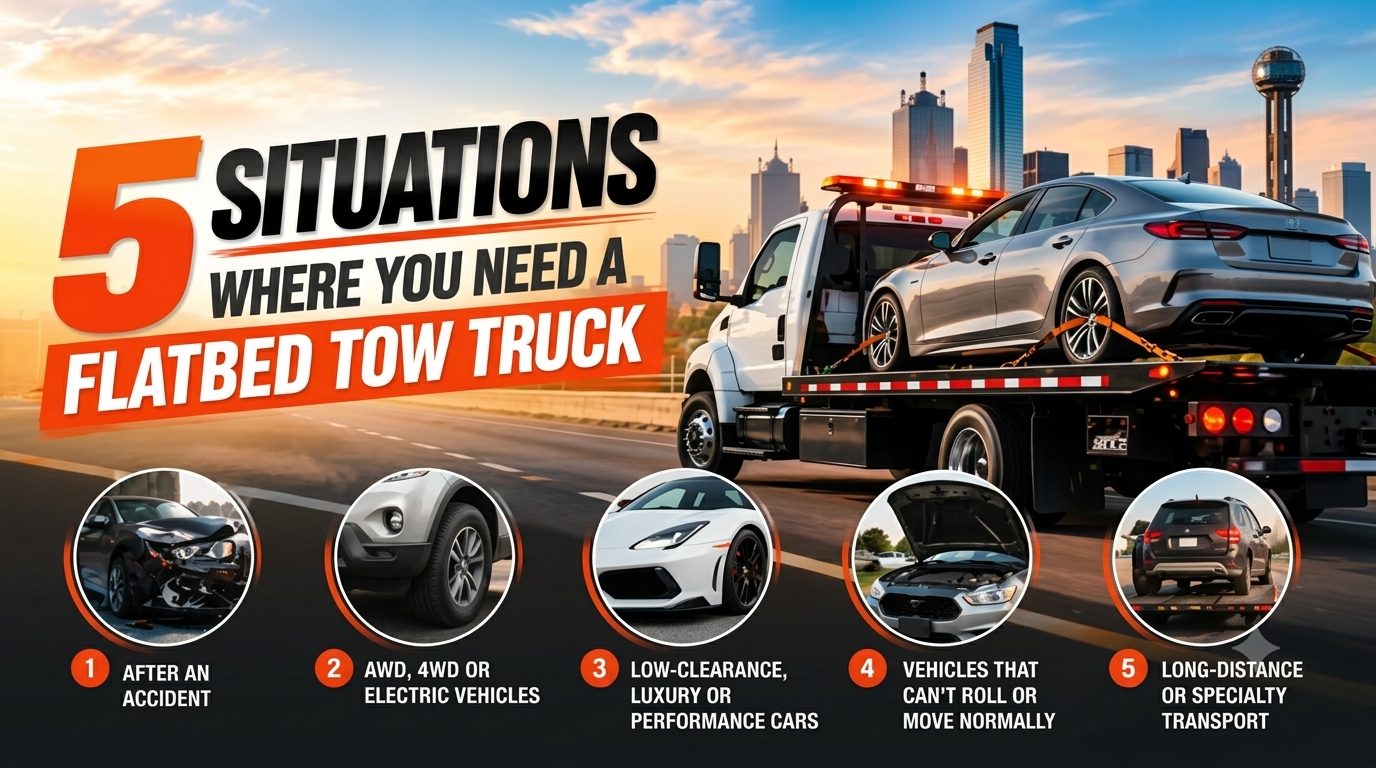
If you are standing beside a disabled car wondering what to request, here are five common situations where flatbed towing may be the right choice.
What Is a Flatbed Tow Truck?
A flatbed tow truck—often called a rollback—has a long platform at the rear of the truck. The bed tilts toward the ground, and the disabled vehicle is either driven or carefully winched onto it.
Once loaded, the vehicle is secured and the platform returns to its transport position.
The biggest difference between flatbed and wheel-lift towing is what happens to your wheels.
With a wheel-lift truck, one end of the vehicle is lifted while another pair of wheels may remain on the road. With a flatbed, the entire vehicle travels on the truck rather than rolling behind it.
That simple difference is why flatbeds are commonly chosen when minimizing wheel, tire, drivetrain, suspension, or body movement is important.
| Situation | Why a Flatbed May Be Better |
| Accident damage | Keeps damaged wheels and suspension off the road |
| AWD/4WD or certain EVs | Can prevent unwanted drivetrain or wheel rotation |
| Low-clearance vehicles | Reduces the risk of scraping bodywork or undercarriage |
| Major mechanical failure | Vehicle can be winched aboard without relying on it to roll normally |
| Long-distance/specialty transport | Keeps the vehicle fully supported during the trip |
1. Your Vehicle Has Been Damaged in an Accident
A collision is one of the clearest situations where a flatbed tow truck can make sense.
Even when a damaged vehicle looks movable, there may be problems you cannot see from the roadside. A bent wheel, damaged axle, broken suspension component, steering problem, or loose body panel can make conventional towing difficult or potentially cause additional damage.
Imagine your front wheel has been pushed out of alignment after an impact. Allowing that wheel to continue rolling during a tow may not be a risk worth taking.
A flatbed allows the damaged vehicle to be loaded onto a platform and transported with its wheels off the pavement.
Signs you should mention to the towing dispatcher
Tell the dispatcher if you notice:
- wheels pointing at unusual angles
- damaged or collapsed suspension
- broken steering
- severe tire or wheel damage
- leaking fluids
- loose bumpers or body panels
- a vehicle that cannot roll normally
Do not try to decide whether a badly damaged vehicle is safe to drive based only on its appearance. After a serious collision, prioritize your safety, move away from traffic when possible, and let professionals determine how the vehicle should be recovered.
2. You Drive an AWD, 4WD or Certain Electric Vehicle
Modern drivetrains have made choosing the correct towing method more important.
With an all-wheel-drive (AWD) or four-wheel-drive (4WD) vehicle, the wheels can be connected through components such as differentials, driveshafts and a transfer case. Depending on the vehicle, towing it with some wheels turning on the road while others remain raised can potentially damage drivetrain components.
This does not mean every AWD or 4WD vehicle follows exactly the same towing procedure. Manufacturers specify approved towing methods based on the vehicle’s drivetrain and design.
That is why your owner’s manual matters.
Electric vehicles deserve similar attention. EV towing procedures can be particularly model-specific. For example, some manufacturers require or recommend transporting the vehicle with all four wheels off the ground.
What should you do?
Before your vehicle is moved:
- Tell the towing company that your vehicle is AWD, 4WD, hybrid or electric.
- Give them the exact make and model.
- Check the towing or emergency-transport section of your owner’s manual when possible.
- Request equipment appropriate for the manufacturer’s instructions.
If you are unsure, tell the dispatcher rather than guessing. A few minutes spent confirming the correct towing procedure can help prevent a breakdown from turning into a drivetrain repair.
3. You Own a Low-Clearance, Luxury, Classic or Performance Car
Picture a sports car with a low front splitter being pulled onto towing equipment at a steep angle.
That is exactly the type of situation where owners start worrying about scraping.
Performance cars, modified vehicles and some luxury vehicles sit much closer to the pavement than ordinary passenger cars. Their front bumpers, side skirts, exhaust systems, aerodynamic panels and other underbody components can be vulnerable when loading angles are too steep.
Flatbed towing can offer more controlled loading for these vehicles, particularly when the operator uses the correct ramps, approach angle and loading equipment.
Flatbeds are commonly considered for:
- sports and exotic cars
- lowered vehicles
- classic and collector cars
- luxury vehicles
- cars with aftermarket body kits
- vehicles with expensive wheels or delicate exterior components
For a collector or specialty vehicle, the goal may also be more than simply getting from Point A to Point B. You may want to avoid unnecessary tire rotation, mileage and exposure to the road.
When calling for a tow, mention that your car has low ground clearance or modifications. That information helps the towing company determine what equipment will be needed before arriving.
4. Your Car Cannot Roll, Steer or Move Normally
Not every breakdown is a dead battery.
Sometimes the car physically cannot move.
A transmission may fail. A wheel bearing can seize. The steering can lock. An axle may break. Multiple tires may be damaged. The vehicle may be stuck in park or simply be unable to roll safely.
These problems can make a conventional tow more complicated because the vehicle’s remaining wheels may not rotate or track normally.
A flatbed can allow the vehicle to be carefully winched onto the truck rather than relying on it to travel on its own wheels throughout the tow.
Consider requesting a flatbed assessment when your vehicle has:
- a broken axle
- severely damaged wheels or tires
- steering failure
- major suspension damage
- transmission problems
- seized wheels
- an inability to shift into neutral
The key is communication. When you call a towing company, don’t simply say, “My car won’t start.”
Explain what happened.
If you heard a loud impact before the wheel stopped turning, say so. If the vehicle is stuck in park, tell the dispatcher. If a wheel is folded underneath the car, mention it immediately.
Those details help the towing company send appropriate equipment instead of discovering the problem after arriving.
5. You Need Safer Transport for a Longer Trip
A tow is not always a five-mile journey to the nearest repair shop.
Your vehicle may need to go to a dealership across the metro area, a specialist mechanic in another city, a restoration shop, or another destination farther away.
For longer transport, many owners prefer a flatbed because the vehicle rides entirely on the carrier.
Its wheels do not continuously rotate against the pavement, and the vehicle is not accumulating road-contact wear during the trip.
Flatbed transport can therefore be especially useful for:
- non-running vehicles going to specialist repair facilities
- classic and collector cars
- vehicles purchased or sold privately
- vehicles being transported to dealerships
- performance vehicles heading to an event or shop
- longer-distance towing after a breakdown
Before booking a longer tow, ask how your vehicle will be loaded and secured and whether the truck is suitable for its weight, dimensions and condition.
Flatbed vs. Wheel-Lift Towing: Which One Do You Actually Need?
Flatbed towing is useful, but that does not mean every ordinary tow requires one.
A wheel-lift truck can be appropriate for many standard passenger vehicles when the vehicle’s condition and manufacturer instructions allow it. Wheel-lift trucks can also be useful where maneuvering space is limited.
The correct choice depends on several factors: your vehicle’s drivetrain, condition, ground clearance, manufacturer’s towing instructions, pickup location and destination.
A reputable towing provider should ask questions about the vehicle rather than automatically treating every tow exactly the same.
What to Tell a Tow Company Before They Dispatch a Truck
When you are stranded, providing the right information can make the towing process much smoother.
Give the dispatcher your exact location and destination, plus your vehicle’s make, model and approximate year. Mention whether it is AWD, 4WD, hybrid or electric, and describe any accident or mechanical damage.
Also tell them if the vehicle:
- will not shift into neutral
- has locked or damaged wheels
- has unusually low ground clearance
- is parked in a tight garage or difficult location
- has been modified
- cannot steer or brake normally
You do not need to diagnose the mechanical problem yourself. You simply need to describe what you can see and what happened.
Need a Flatbed Tow Truck in Dallas–Fort Worth?
Getting stranded is stressful enough without wondering whether the wrong towing method could make the problem worse.
If you need towing in the Dallas–Fort Worth area, DA Cheap Towing Company provides flatbed and other towing options for different vehicle types and situations throughout DFW. The company offers 24/7 dispatch and serves Dallas, Fort Worth and surrounding communities.
When calling, explain your vehicle type, condition and location so the team can determine which towing equipment is appropriate for the job.
The important part isn’t simply getting a tow truck. It is getting the right tow truck for your vehicle.
Frequently Asked Questions About Flatbed Towing
When do I need a flatbed tow truck?
A flatbed is commonly recommended for accident-damaged vehicles, cars that cannot roll or steer properly, low-clearance and specialty vehicles, certain AWD/4WD vehicles, some EVs, and situations where keeping all four wheels off the road is preferable. Always follow your vehicle manufacturer’s towing instructions.
Is a flatbed safer for an AWD vehicle?
It can be. Because a flatbed keeps all four wheels off the road, it avoids wheel rotation during transport. However, towing requirements vary by manufacturer and model, so check your owner’s manual or ask a qualified towing professional.
Can electric vehicles be flatbed towed?
Yes, and some EV manufacturers specifically recommend flatbed transport. EV towing procedures vary, so the towing operator should follow the manufacturer’s instructions for your exact vehicle.
Can a flatbed tow a car that will not start?
Yes. A vehicle does not normally need to run to be loaded onto a flatbed. Appropriate winching and loading equipment can be used to move a non-running vehicle onto the carrier.
Is flatbed towing good for lowered cars?
Flatbed towing is often preferred for lowered, sports and performance vehicles because the operator can use appropriate loading techniques to reduce the risk of scraping the bumper or undercarriage. Be sure to tell the dispatcher how low or modified the vehicle is.
Should I use a flatbed after a car accident?
If the collision has damaged the wheels, steering, suspension, axle or other components that prevent the vehicle from rolling normally, a flatbed may be the safer option. The towing professional should assess the vehicle and select suitable recovery equipment.
Is a flatbed always better than a regular tow truck?
Not necessarily. Wheel-lift towing can be appropriate for many routine towing situations. Flatbeds become particularly valuable when the vehicle’s drivetrain, damage, ground clearance, value or manufacturer requirements make keeping all four wheels off the road preferable.
Conclusion
Choosing a tow truck may seem like a small decision when you are stranded on the side of the road, but the wrong towing method can create unnecessary risk for an already-disabled vehicle.
A flatbed tow truck is particularly useful after serious accidents, for certain AWD/4WD and electric vehicles, for low-clearance or valuable cars, when wheels or steering cannot function normally, and for longer or specialized vehicle transport.
When in doubt, don’t guess. Tell the towing company exactly what happened, provide your vehicle details, and check the manufacturer’s towing instructions when available.
The safest tow is not necessarily the biggest truck or the cheapest option. It is the towing method that matches your vehicle, its condition and the situation you’re in.